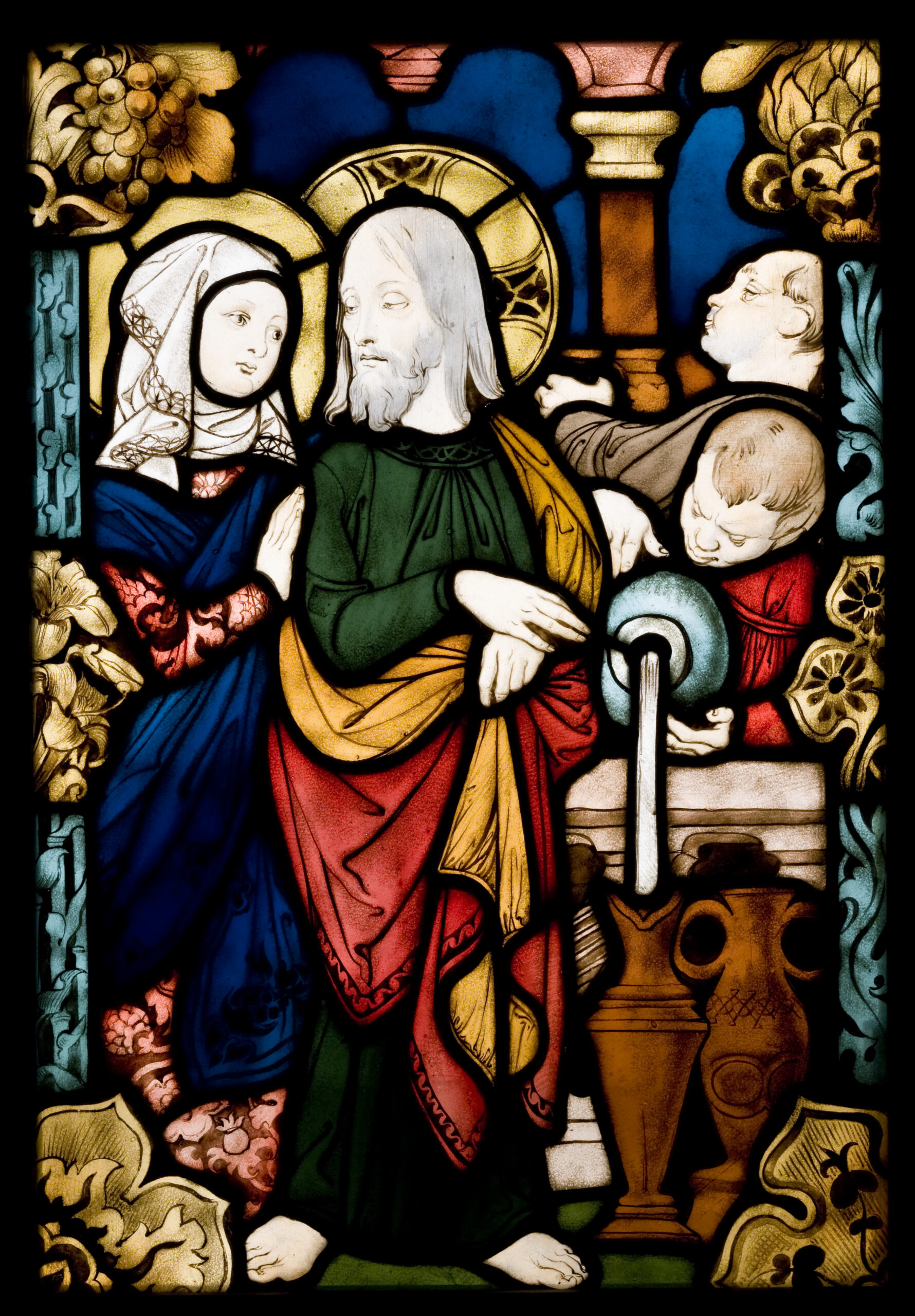
This coming Sunday (the Second Sunday after the Epiphany, or Epiphany 2), we will hear about how Jesus turned the water into wine at Cana, for a wedding. This is a beautiful text, giving us the opportunity to talk both about marriage, and the Scriptural use of wine.
The Scriptures are not silent regarding wine and its uses. Wine is a central part of the Scriptures, in part because wine is a staple of Mediterranean cuisine, and also because of the Lord’s foreshadowing to His blessed Supper. In the Scriptures, wine plays five main roles: a mark of wealth or prosperity; to be used for enjoyment or mirth; as an allegory for God’s wrath or judgment; that which is good, or a comparison for it; and for liturgical use. All of these roles find their end in the Holy Supper, as God, in His infinite foreknowledge, ordained wine and knew the blessed Supper which He would offer His Church in the New Testament.
Wealth
Wine appears throughout the Prophets and the Law as a mark of God’s promise to provide prosperity and wealth to the land of Israel while they live in the Promised Land. God repeatedly promises good wine (Deut 7:13)1 and even the best wine (Num 18:12). Wine is also used to show the wealth or providence of God in other nations, such as of the whore of Babylon in Rev 18:13, Dan 5, and Ps 4:7. Melchizedek serves as a narrative example. In Gen 14 he brings out bread and wine to offer Abraham hospitality as he returns from his victory in battle.2 In contrast, while the giving of good wine is a mark of wealth and prosperity, the taking away and lack of wine is also a mark of God’s judgment. The prophets use this as shorthand to indicate judgment, e.g. Isa 62, Jer 48, and Lam 2. To plant a vineyard and not drink its wine is a curse in Deut 28:39.3
Mirth
The Psalmist famously says, “Wine gladdeneth the heart,” (Ps 104:15).4 Throughout the Scriptures, wine appears at parties, as a marker of rejoicing, and as an improver of gloomy moods. Proverbs says that wine is for those of a heavy or “bitter heart,” (Prov 31:6), and it makes merry (despite the house being a mess, Eccl 10:19). Wine is to be drunk in celebration that God has saved me (Eccl 9:7 and Zech 9:17), but it is not to be drunk in mourning for sins (Isa 24:7, 9).
Wrath
Wine serves as the channel of God’s wrath in two ways. The first sense is that the prophets use the image of drinking a cup, usually bitter, as the execution of God’s wrath upon a nation or people (Isa 28, 29, 51; Jer 23:9). The wine of wrath is shown in the Psalms (Ps 60:3, 75:8), and is poured out for the sins of the whore of Babylon. (Rev 14:8-10, 16:19, 18:3) The second sense is that drunkenness is a sin and deserves God’s wrath, and that drunken stumbling is a picture of the confusion, terror, and disorientation the wicked will suffer when God’s wrath falls upon them. A vignette of this vice playing out is found in Noah’s vineyard (Gen 9). Noah plants a vineyard, reaps the grapes, makes a wine, and gets so drunk off it, he falls asleep in his tent with his “nakedness” showing. This is shameful both in the sense that public drunkenness is both a sin and its own punishment, and also that Noah reveals his modest parts out of his drunkenness. The New Testament does not change stance on wine, and both Peter and Paul exhort their hearers to avoid drunkenness repeatedly (Eph 5:18, 1 Tim 3:3, Titus 1:7). Routine drunkenness is a mark of paganism (1 Pet 4:3), and older women are to be cautious, as they can be particularly susceptible to this vice (Titus 2:3). The Proverbs and the Prophets also teach us that alcoholism is folly (Prov 20:1, Isa 5:11, Hos 3-4, Joel 1).
Good
Wine is good in the sense that it is in itself a good thing, a gift given from God (marker of wealth or prosperity, and promoter of mirth), and also that when it is especially good, it is easily noticed and appreciated. The Shulamite sings of her bridegroom, “For your love is better than wine.” (Song 1:2). He responds later, “How much better than wine is your love,” (Song 4:10) and again later, “Let now your breasts be like clusters of the vine, The fragrance of your breath like apples, And the roof of your mouth like the best wine” (Song 7:8-9).
God promises to give not only good wine to Israel in the promised Land (Deut 7:13) but the best wine (Num 18:12). He surely provided it throughout the history of Israel, but He delivered it in person to the wedding-goers at Cana in John 2. There the master of the feast calls the groom to say, “You have kept the good wine until now!” (John 2:10)
Liturgical
Wine was important in the liturgical life of Israel. Alongside both of the daily sacrifices of the yearling lambs, there was to be a “one-fourth of a hin of wine” offered as a drink offering (Exod 29:40).5 Once again, alongside the wave-offering which is offered after the first harvest, another quarter hin of wine (Lev 23:13). The offering of wine is to accompany any burnt offering made either “to fulfill a vow or as a freewill offering or in your appointed feasts” (Num 15:3). A quarter hin for lambs, a third hin for rams, and half a hin for bulls were prescribed respectively.
The priests are forbidden across the board from drinking any wine before performing their services in the tabernacle. The first command against this, given force by the threat of instant death, is given to Aaron just after the corpses of his sons are taken out of the tabernacle (Lev 10:9). This command is reiterated by the prophet Ezekiel in chapter 44, where the priests are also told that they must groom their hair properly, and only marry virgins or the widows of priests. However, though they are forbidden from drinking wine prior to serving in the tabernacle, they are commanded to drink the aforementioned drink-offerings in the Holy Place (Deut 12:17, 14:23-26).
The Nazirites are sworn to abstain from wine and all alcohol, especially that made of grapes (Num 6:3). However, at the fulfillment of the allotted time of his vow, the Nazirite engages in a series of rituals and offerings to the Lord, including the shaving and burning of his hair. The rituals conclude, “After that the Nazirite may drink wine.” (Num 6:20).
Conclusion
This is a general survey of the ways in which the Scriptures use wine, and its attitudes toward it. From it, we see that wine is a rich gift which God has given us in Creation, which is to be enjoyed in moderation. This rich gift then ultimately points us to Christ’s Holy Supper, where He feeds us His Body and Blood, for the forgiveness of our sins.
1 All Scripture quotes, unless otherwise noted, are taken from the New King James Version.
2 See Isa 55, Jer 40, Dan 5, Hos 2, 7-9, 14, Joel 2, and Amos 9 for more examples. In contrast, the image occurs in Is. 36 as the Assyrians mock Hezekiah.
3 Other instances of wine as curse occur in Zeph 1:13, Mic 6:15.
4 King James (Authorized) Version.
5 Cf. Num 28:14